NTRAF separates aspiration from demonstrated maturity, so reviewers can see what is validated and what remains assumed.
National Technology Readiness Assessment Framework
Every breakthrough begins as uncertainty.
NTRAF gives that uncertainty a structure — a constitution for accountable technology judgment, anchored in evidence and operational proof.

Why NTRAF exists
Innovation fails in the valley between research and reality.
The framework counters optimism bias by asking what has been proven, where it was proven, and which evidence supports the claimed maturity.
The framework exposes the engineering bridge between discovery, prototype validation, pilot operation, and production readiness.
A shared TRL scale helps founders, reviewers, funders, labs, and deployment partners discuss risk with the same vocabulary.

The constitution unveils itself
A formal protocol for accountable technology judgment.
NTRAF gives reviewers a structured way to classify maturity, document rationale, identify shortfalls, and plan progression.
The readiness ladder
The scroll becomes an ascent from discovery to deployment.
Each TRL adds evidence, environmental realism, engineering confidence, and operational consequence.

Signature sequenceConcept to manufacturing
Entropy decreases as maturity rises: particles become systems, systems become prototypes, and prototypes become deployable infrastructure.
Basic principles observed and reported
Lowest level of technology readiness. Scientific research begins to be translated into applied research and development.
Literature reviewResearch notesInitial hypothesis
TRL 4 to TRL 6
This is where science becomes engineering.
The framework treats the middle TRLs as a decisive bridge: components integrate, prototypes gain fidelity, and pilot evidence replaces promise.
Lab validationRelevant environmentPilot-scale demonstration
The TRA engine
Assessment is a procedure, not a claim.
NTRAF moves from Level 0 pre-assessment to anticipated TRL, then validates the claim through critical and supporting criteria.

Pass
Validation pulseReadiness stabilizes
Workflow mapPre-assessment to certification
A quick indicator sheet places the technology in a proof-of-concept, prototype, or commercialization band.
A top-down yes/no walk from TRL 9 to TRL 1 identifies the founder's claimed or anticipated TRL.
Critical and supporting questions by TRL, technology, manufacturing, and programmatic category turn the anticipated TRL into a certified TRL.
ABIF reviewers inspect rationale and evidence, then approve, request changes, or export the TRA report.
Evidence room
Readiness requires proof, not declarations.
Every level needs traceable artifacts. Missing critical evidence creates a gap plan or a lower certified TRL.

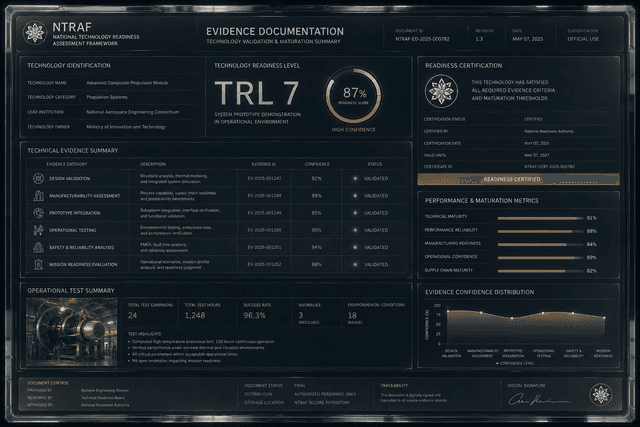
Experimental, lab, field, and operational records tied to a claimed TRL.
Performance, repeatability, yield, safety, cost, schedule, and manufacturability signals.
Component, subsystem, interface, and cross-technology evidence.
Shortfalls, downgrade logic, planned progression, and review decisions.
Governance layer
Assessment without governance is theater.
The TRA report turns technical evidence into an accountable review record with rationale, risk, shortfalls, and progression planning.
TRA report assembly
The output is not a score alone. It is a review-grade explanation of what is mature, what is missing, and what must happen next.
Sector worlds
One framework, multiple readiness pathways.
NTRAF formalizes annexures for Healthcare and Pharmaceuticals (Annexure A) and Software (Annexure B). Other sectors apply the same TRL logic with domain-specific extensions.

Healthcare and pharma
Annexure A
Clinical safety and regulatory gates.
Healthcare readiness adds preclinical evidence, clinical trials, GMP lots, approval pathways, and post-market surveillance.

National readiness network
A common language for Indian innovation.
When labs, startups, funders, manufacturers, and deployment partners use the same maturity protocol, readiness becomes comparable and governable.

Final chamber